Showing posts with label GlobalWarming. Show all posts
Temperatures 2,000 years ago about 1 deg C warmer than now

Temperatures 2,000 years ago about 1 deg C warmer than now

Well done article in the UK Daily Mail. Where is the coverage in the US about this? Note the importance of the sun in the changing temperatures.
How did the Romans grow grapes in northern England? Perhaps because it was warmer than we thought.

A study suggests the Britain of 2,000 years ago experienced a lengthy period of hotter summers than today.

German researchers used data from tree rings – a key indicator of past climate – to claim the world has been on a ‘long-term cooling trend’ for two millennia until the global warming of the twentieth century.

This cooling was punctuated by a couple of warm spells.

These are the Medieval Warm Period, which is well known, but also a period during the toga-wearing Roman times when temperatures were apparently 1 deg C warmer than now.

They say the very warm period during the years 21 to 50AD has been underestimated by climate scientists.

Lead author Professor Dr Jan Esper of Johannes Gutenberg University in Mainz said: ‘We found that previous estimates of historical temperatures during the Roman era and the Middle Ages were too low.

‘This figure we calculated may not seem particularly significant, however it is not negligible when compared to global warming, which up to now has been less than 1 deg C.’

In general the scientists found a slow cooling of 0.6C over 2,000 years, which they attributed to changes in the Earth’s orbit which took it further away from the Sun. . . .

The UK Guardian has the resource available here.  The three top countries in terms of emissions in order are China, US, and India.
Yet, how their emission levels per capita have change over time is pretty startling.  As far as I can tell, the US emissions per capita appears to have fallen the largest absolute amount, though it is still higher than a lot of other countries.  Personally, CO2 output doesn't concern me (see these links here).


Godfather of Global Warming sets environmentalists straight

Godfather of Global Warming sets environmentalists straight

SO much for the oft repeated claim of consensus on man-made Global warming being a real threat.  You have to read the Toronto Sun piece to see his discussion taking on the claim that "the science is settled."

Two months ago, James Lovelock, the godfather of global warming, gave a startling interview to msnbc.com in which he acknowledged he had been unduly “alarmist” about climate change. . . .
Lovelock is a world-renowned scientist and environmentalist whose Gaia theory — that the Earth operates as a single, living organism — has had a profound impact on the development of global warming theory. . . .
Having observed that global temperatures since the turn of the millennium have not gone up in the way computer-based climate models predicted, Lovelock acknowledged, “the problem is we don’t know what the climate is doing. We thought we knew 20 years ago.” Now, Lovelock has given a follow-up interview to the UK’s Guardian newspaper in which he delivers more bombshells sure to anger the global green movement, which for years worshipped his Gaia theory and apocalyptic predictions that billions would die from man-made climate change by the end of this century.
Lovelock still believes anthropogenic global warming is occurring and that mankind must lower its greenhouse gas emissions, but says it’s now clear the doomsday predictions, including his own (and Al Gore’s) were incorrect. . . .
“It just so happens that the green religion is now taking over from the Christian religion,” Lovelock observed. “I don’t think people have noticed that, but it’s got all the sort of terms that religions use … The greens use guilt. That just shows how religious greens are. You can’t win people round by saying they are guilty for putting (carbon dioxide) in the air.” . . .
“so-called ‘sustainable development’ … is meaningless drivel … We rushed into renewable energy without any thought. The schemes are largely hopelessly inefficient and unpleasant. I personally can’t stand windmills at any price.” . . .
So if geoengineering works, how much does that reduce any claimed externality from carbon emissions?

So if geoengineering works, how much does that reduce any claimed externality from carbon emissions?

Reducing the direct sunlight reaching the ground by 20 percent seems like a pretty large effect to me.  Will the claimed necessity of a carbon tax be adjusted for this possibility?  Personally, I think that warmer weather on net produces more good than bad.  From New Scientist:

Blue skies would fade to hazy white if geoengineers inject light-scattering aerosols into the upper atmosphere to offset global warming. Critics have already warned that this might happen, but now the effect has been quantified.
Releasing sulphate aerosols high in the atmosphere should in theory reduce global temperatures by reflecting a small percentage of the incoming sunlight away from the Earth. However, the extra particles would also scatter more of the remaining light into the atmosphere. This would reduce by 20 per cent the amount of sunlight that takes a direct route to the ground, and it would increase levels of softer, diffuse scattered light, says Ben Kravitz of the Carnegie Institution for Science in Stanford, California. . . . .
This article in Climatic Change (2006) indicates that this effect can be achieved at a cost of $25 to $50 billion.  
This can be achieved by a continuous deployment of about 1–2 Tg S per year for a total price of US $25–50 billion . . . . 
Compare that to the carbon taxes being proposed for just the United States.  Here is a proposal by Obama that talked about the tax revenue amounting to $80 billion a year.  I have no estimate of the deadweight loss.  From the WSJ:
The cost of energy for consumers would be driven higher in President Barack Obama's proposed budget by a carbon cap-and-trade system that is projected to raise about $80 billion a year starting in 2012. . . .The budget projects raising $645 billion from the auction of emissions credits between 2012, when the system kicks in, and 2019. . . .
The US would probably find it preferable to put the sulphur in the atmosphere all on its own. 


More information is available here.

Remember how Arctic Ice was supposedly disappearing?

For some of the earlier debate, see this post by David Friedman.  I noticed this note at the National Weather service:

THIS HAS BEEN AN EXTREME WINTER FOR SEA ICE IN THE BERING SEA AND NOW
WE HAVE BROKEN THE RECORDS FOR MOST NUMBER OF DAYS WITH ICE AT BOTH
SAINT PAUL ISLAND AND SAINT GEORGE ISLAND.
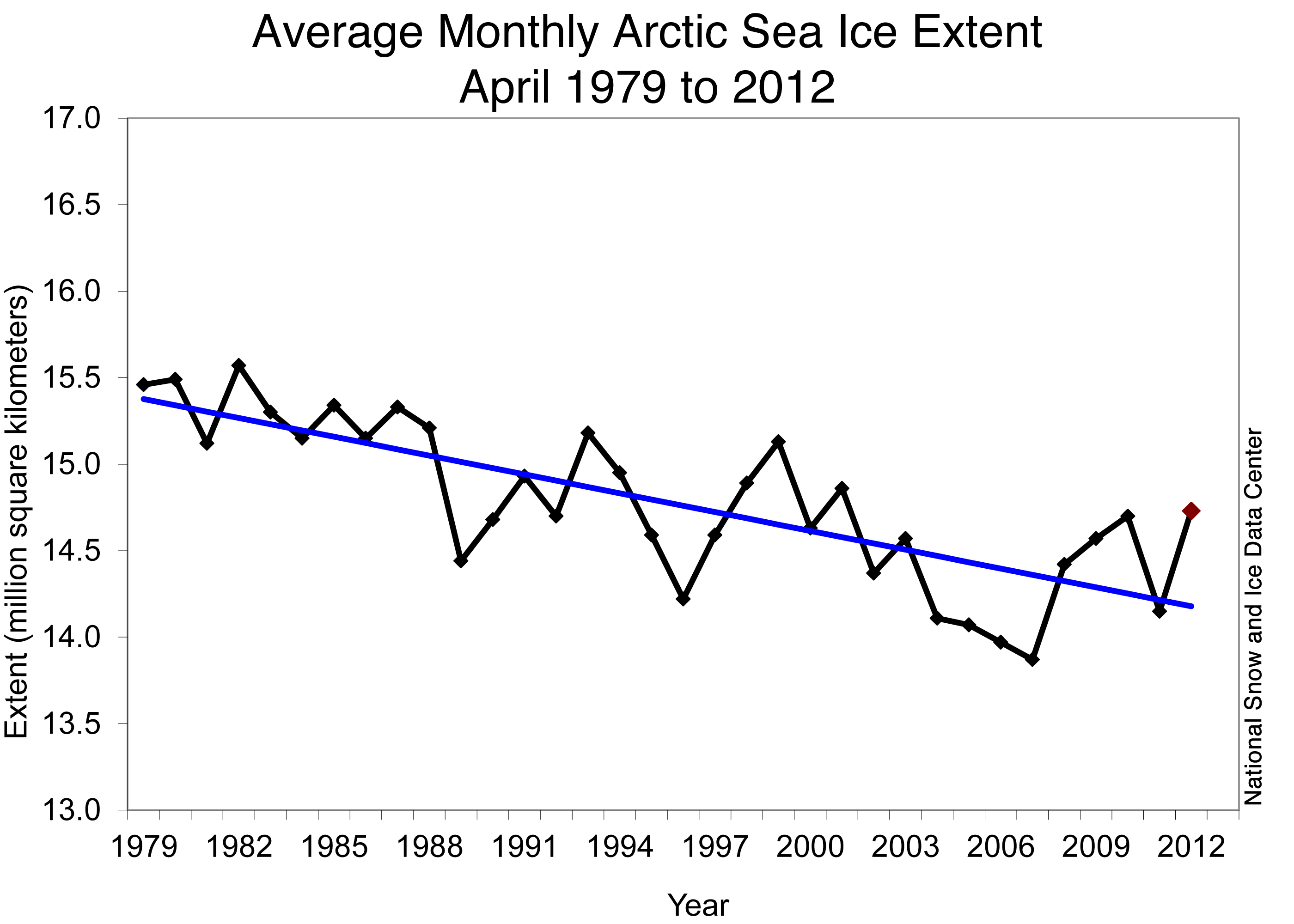
Th discussion at the DSIDC changes daily so I took this screen shot:


The trend since the late 1970s is available here.  Given that global temperatures have been rising since that point it makes me wonder why they picked that starting date.  But in any case, since 2000, the level of Arctic sea ice has remained at about the same level.

Climate models have done a horrible job predicting recent trends, but they can't even explain the past

Climate models have done a horrible job predicting recent trends, but they can't even explain the past

Predicting the future is much harder than simply running a regression that explains the past.  The whole point of a regression is to fit a line to data.  Presumably they must have used past data at some point to get their idea of what causes climate to change.  If they can't go back then and explain the changes, it probably means that their models deviated then from the results that they had previously gotten.  The whole thing is pretty troublesome.  From Watts Up with that:


One of the main points of criticism of the CO2-dominated climate models is that they fail to reproduce the temperature fluctuations over the last 10,000 years. This surprises no one as these models assign scant climate impact to major factors, i.e. the sun. As numerous IPCC-ignored studies show, the post-Ice Age temperature curve for the most part ran synchronously with solar activity fluctuations. The obvious discrepancy between modeled theory and measured reality has been brought up time and again.
The journal Climate of the Past Discussions has published a new paper written by a team led by Gerrit Lohmann of the Alfred Wegener Institute (AWI) in Bremerhaven, Germany. The group compared geologically reconstructed ocean-temperature data over the last 6000 years to results from modeling. If the models were indeed reliable, as is often claimed, then there would be good agreement. Unfortunately in Lohmann’s case, agreement was non-existent.
Lohmann et al plotted the geologically reconstructed temperatures and compared them to modeled temperature curves from the ECHO-G Model. What did they find? The modeled trends underestimated the geologically reconstructed temperature trend by a factor of two to five. Other scientists have come up with similar results (e.g. Lorenz et al. 2006, Brewer et al. 2007, Schneider et al. 2010). . . .

So how does this fit in with all the predictions?: "No global warming for 15 years"

From the Global Warming Policy Foundation:
The graph shows the global annual average temperature since 1997. No statistically significant trend can be discerned from the data. The only statistically acceptable conclusion to be drawn from the HadCRUT4 data is that between 1997 – 2011 it has remained constant, with a global temperature of 14.44 +/- 0.16 deg C (2 standard deviations.) . . .
I am sure that a lot of predictions can be pointed to.
In June 1986, Dr. James Hansen made a prediction to an AP newspaper reporter, which was carried in Oxnard, CA, of a 2 degree temperature rise by 2006. . . .
Temperatures did rise, but they rose by about 0.4 degrees.
False identities in the Global warming debate

False identities in the Global warming debate

From the Washington Post:

Legislation to fight global warming has disappeared from Washington’s policy agenda, but the battle over climate science continues to escalate.

The latest skirmish culminated in the admission Monday night by Peter Gleick, a climate scientist and author, that he assumed a fake identity to obtain documents that would expose the inner workings of a climate skeptic group.

“My judgment was blinded by my frustration with the ongoing efforts — often anonymous, well-funded and coordinated — to attack climate science and scientists and prevent this debate, and by the lack of transparency of the organizations involved,” Gleick wrote in a post on his Huffington Post blog.

Gleick’s admission “is the latest in an escalating spiral of polarizing warfare between self-described ‘Climate Hawks’ and so-called Climate Deniers,” which leaves the majority of scientists and the public “caught in the crossfire,” American University professor Matthew C. Nisbet, who studies the issues, wrote in a blog entry. . . .
Sixteen prominent scientists say "no need to panic about Global Warming"

Sixteen prominent scientists say "no need to panic about Global Warming"

From the WSJ:

A candidate for public office in any contemporary democracy may have to consider what, if anything, to do about "global warming." Candidates should understand that the oft-repeated claim that nearly all scientists demand that something dramatic be done to stop global warming is not true. In fact, a large and growing number of distinguished scientists and engineers do not agree that drastic actions on global warming are needed. . . .
So are environmentalists admitting that their other green energy offerings aren't working?

So are environmentalists admitting that their other green energy offerings aren't working?

The beginning of this article sure seems to concede a lot. It is too bad that this wasn't understood before we put all the Stimulus dollars into all this. From ABC News:

Geothermal energy developers plan to pump 24 million gallons of water into the side of a dormant volcano in Central Oregon this summer to demonstrate new technology they hope will give a boost to a green energy sector that has yet to live up to its promise.

They hope the water comes back to the surface fast enough and hot enough to create cheap, clean electricity that isn't dependent on sunny skies or stiff breezes — without shaking the earth and rattling the nerves of nearby residents.

Renewable energy has been held back by cheap natural gas, weak demand for power and waning political concern over global warming. Efforts to use the earth's heat to generate power, known as geothermal energy, have been further hampered by technical problems and worries that tapping it can cause earthquakes. . . .
Ben Stein loses gig for being "unsure" about man-made global warming, but that is only a part of the story

Ben Stein loses gig for being "unsure" about man-made global warming, but that is only a part of the story

Ben Stein's unsureness about man-made global warming (note he was just "unsure") seems to have cost him this job for a Japanese company. From Reuters:

The conservative pundit and actor -- and former Nixon speechwriter -- alleges that his position on climate change had him kicked off a $300,000 acting gig, only to be replaced by a lookalike.

Stein filed a discrimination suit against Japanese company Kyocera Corporation and New York ad agency Seiter & Miller Advertising, in Los Angeles Superior Court on Wednesday. . . .

In February, Jao called Hurwitz and said "questions had been raised by defendant Kyocera about whether [Stein's] views on global warming and on the environment were sufficiently conventional and politically correct for Kyocera," according to the suit.

Stein then told Kyocera and Seiter & Miller that he was extremely concerned about the environment but unsure whether humans are responsible for global warming.

"He also told Hurwitz to inform defendants that, as a matter of religious belief, he believed that God, and not man, controlled the weather," the suit claims.

That same month, Seiter & Miller President Livingston Miller emailed Hurwitz, telling her the agency had decided to withdraw its offer. . . .


The person who replaced Stein is University of Maryland economist Peter Morici. It is pretty ironic that Morici is working for a Japanese firm that is trying to sell its products in the US given that he blames Japanese and Chinese companies doing this as the cause of the so-called "Great Recession."

The seeds of the Great Recession were sowed by an imbalance of demand between the United States and Western Europe, on the one hand, and China and other Asian economies, on the other. . . .


Despite Morici hating our trade deficit with Japan, it was global warming that seemed to be the more important issue for Kyocera.
American Taxpayers paying for hidden climate data?

American Taxpayers paying for hidden climate data?

A new piece by my son Maxim:

Are your tax dollars helping hide global warming data from the public? Internal emails leaked as part of “Climategate 2.0” indicate the answer may be "Yes."
The original Climategate emails -- correspondence stolen from servers at a research facility in the U.K. and released on the Internet in late 2009 -- shook up the field of climate research. Now a new batch posted in late November to a Russian server shows that scientists at the University of East Anglia’s Climatic Research Unit refused to share their U.S. government-funded data with anyone they thought would disagree with them.
Making that case in 2009, the then-head of the Research Unit, Dr. Phil Jones, told colleagues repeatedly that the U.S. Department of Energy was funding his data collection -- and that officials there agreed that he should not have to release the data. . . .
Hurricane forecasts apparently no better than a random guess

Hurricane forecasts apparently no better than a random guess

This is almost too hard for me to believe. You would have to think we know enough to narrow down the range of possibilities a little bit. But if we really can't forecast the number of hurricanes a few months in advance, what about longer term forecasts? Philip J. Klotzbach and William M. Gray write this:

We have suspended issuing quantitative forecasts at this extended-range lead time, since they have not proved skillful over the last 20 years. We attribute the primary reasons for the lack of skill of our early December forecast due to the breakdown of several long-term relationships that worked well in many years of hindcast data, but not in real-time forecasting.

We would never have issued a seasonal hurricane forecast that did not show significant skill on many years of hindcast data. In addition, no statistical or dynamical models have shown skill at predicting El Niño – Southern Oscillation (ENSO) at this extended forecast lead time of 9-12 months. . . .
Canada formally drops out of the Kyoto Protocol

Canada formally drops out of the Kyoto Protocol

The amazing thing is that other developed countries aren't also dropping out of the treaty. From the AFP:

Canada became the first country to formally withdraw from the Kyoto Protocol, saying the pact on cutting carbon emissions was preventing the world from effectively tackling climate change.
"We are invoking Canada's legal right to formally withdraw from Kyoto," Environment Minister Peter Kent said following a marathon UN climate conference in South Africa, at which nations agreed to a new roadmap for worldwide action. . . .
Pulling out of Kyoto now allows Canada to avoid paying penalties of up to CAN$14 billion (US$13.6 billion) for missing its targets. . . .
"Under Kyoto, Canada is facing radical and irresponsible choices if we're to avoid punishing multi-billion-dollar payments," Kent said, noting that Canada produces barely two percent of global emissions.
"To meet the targets under Kyoto for 2012 would be the equivalent of either removing every car, truck, ATV, tractor, ambulance, police car, and vehicle of every kind from Canadian roads or closing down the entire farming and agricultural sector and cutting heat to every home, office, hospital, factory, and building in Canada."
For Kyoto supporters, the anticipated Canadian pullout was expected to be a symbolic blow and badly damage a UN climate process already weakened by divisions. . . .
CO2 changes are found to have smaller impacts on temperature than first claimed

CO2 changes are found to have smaller impacts on temperature than first claimed

From the BBC:

Global temperatures could be less sensitive to changing atmospheric carbon dioxide (CO2) levels than previously thought, a study suggests.

The researchers said people should still expect to see "drastic changes" in climate worldwide, but that the risk was a little less imminent.

The results are published in Science.

Previous climate models have tended to used meteorological measurements from the past 150 years to estimate the climate's sensitivity to rising CO2.

From these models, scientists find it difficult to narrow their projections down to a single figure with any certainty, and instead project a range of temperatures that they expect, given a doubling of atmospheric CO2 from pre-industrial levels.

The new analysis, which incorporates palaeoclimate data into existing models, attempts to project future temperatures with a little more certainty.

Lead author Andreas Schmittner from Oregon State University, US, explained that by looking at surface temperatures during the most recent ice age - 21,000 years ago - when humans were having no impact on global temperatures, he, and his colleagues show that this period was not as cold as previous estimates suggest. . . .

The new models predict that given a doubling in CO2 levels from pre-industrial levels, the Earth's surface temperatures will rise by 1.7C to 2.6C (3.1F to 4.7F).

That is a much tighter range than the one produced by the Intergovernmental Panel on Climate Change's (IPCC) 2007 report, which suggested a rise of between 2.0C to 4.5C. . . .
Climategate 2.0

Climategate 2.0

Watts Up With That has the new batch of emails that were obtained from the UK's University of East Anglia. Watts Up With That describes the emails as: "They’re real and they’re spectacular!"

From Fox News:

"I wasted a part of a day deleting numerous emails and exchanges with almost all the skeptics. So I have virtually nothing. I even deleted the email that I inadvertently sent," wrote Phil Jones, the head of the Climatic Research Unit at the University of East Anglia, according to a December 2008 email leaked to a Russian website Tuesday.
"There might be some bits of pieces of paper, but I'm not wasting my time going through these," the email reads.
The correspondence was one of 5,000 emails stolen from the servers at the University of East Anglia's climate research facility in England and posted online Tuesday. Along with the day-to-day work of science, the emails reveal internal debates, anger at skeptics and even deception from scientists investigation whether man's actions are warming the planet. . . .
According to the December 2008 email exchange, Jones wrote to David Palmer, the information policy and compliance manager for East Anglia's research unit at the time, arguing that unless a fee accompanied a FOIA request for information, he didn't need to bother going to the trouble of replying.
"Dave, do I understand it correctly -- if he doesn't pay the £10 we don't have to respond?" Jones asked. The sum he requested, £10, is worth about $16 U.S. dollars.
"No, we don't have to respond unless we get the £10," Palmer told Jones -- before reading him the riot act over deleting emails, a direct violation of Britain's Data Protection Act of 1998, he said. . . .


What is the Department of Energy doing helping to hide data that they have given to others? From Forbes:

Three themes are emerging from the newly released emails: (1) prominent scientists central to the global warming debate are taking measures to conceal rather than disseminate underlying data and discussions; (2) these scientists view global warming as a political “cause” rather than a balanced scientific inquiry and (3) many of these scientists frankly admit to each other that much of the science is weak and dependent on deliberate manipulation of facts and data. . . .

“Any work we have done in the past is done on the back of the research grants we get – and has to be well hidden,” Jones writes in another newly released email. “I’ve discussed this with the main funder (U.S. Dept of Energy) in the past and they are happy about not releasing the original station data.” . . .
Grad Students wrote the IPCC report

Grad Students wrote the IPCC report

From Fox News:

A scathing new expose on the U.N.’s Intergovernmental Panel of Climate Change -- which sets the world's agenda when it comes to the current state of the climate -- claims that its reports have often been written by graduate students with little or no experience in their field of study and whose efforts normally might be barely enough to satisfy grad school requirements.
Grad students often co-author scientific papers to help with the laborious task of writing. Such papers are rarely the cornerstone for trillions of dollars worth of government climate funding, however -- nor do they win Nobel Peace prizes.
“We’ve been told for the past two decades that 'the Climate Bible' was written by the world’s foremost experts,” Canadian journalist Donna Laframboise told FoxNews.com. “But the fact is, you are just not qualified without a doctorate. In academia you aren't even on the radar at that point.”
The IPCC insists that the lead authors of individual sections of its climate report are indeed the pre-eminent experts in their field.
"These authors are nominated by governments and selected based on expertise,” a spokesman told FoxNews.com. “Author teams on IPCC chapters are a mix of individuals who have excelled in their fields of specialism." . . .